






Facility managers and security directors evaluating access control systems in New Jersey are being pitched cloud-based platforms at nearly every turn right now. Brivo. Avigilon Alta. Kisi. These systems are well-funded, well-marketed, and right for certain facilities. For a significant portion of the institutional and commercial buildings that organizations actually operate across New Jersey, they are the wrong tool, and the infrastructure requirements that make them the wrong tool are rarely disclosed upfront.
This is a framework for evaluating the difference. It covers how each architecture works, what each actually costs to deploy in the New Jersey market, and which categories of facilities belong in each column.
How Cloud-Based Access Control Systems Work
Cloud-based access control follows a consistent model across platforms. A reader at each controlled door connects to the building’s network and communicates with a cloud server. Credential decisions are made in near-real time. When a security administrator updates permissions in the management dashboard, those changes propagate to the door reader through the network. Credentials are delivered via smartphone app, key card, or fob.
The major platforms handle this similarly despite their differences. Brivo operates on roughly hourly sync cycles for credential updates across a cloud dashboard. Avigilon Alta, formerly Openpath, offers faster real-time sync with BLE-based mobile credentials. Kisi is a mobile-first, API-driven platform aimed at tech-forward commercial environments. All three require a live network connection at every door reader in the system.
For a modern Class A office building in Jersey City, a newly constructed corporate campus in Parsippany, or a commercial property in Newark where structured cabling already reaches every door, this model is viable. Remote credential management is convenient. Integration with HR platforms, video systems, and building management software is available. The administrative interfaces are well-designed.
The Infrastructure Requirement That Changes the Cost Calculation
The part of the cloud access control proposal that deserves scrutiny before a facilities or security team commits is the infrastructure assumption embedded in the quote.
Every door controlled by Brivo, Avigilon, Kisi, or any network-connected system requires a wired LAN drop or reliable Wi-Fi at the reader, plus power. In buildings that were not designed with this infrastructure in mind, delivering it means licensed electricians, conduit work, and, in many cases, permit applications for structural work. In New Jersey, licensed low-voltage contractor labor rates are significant. A 30-door deployment that is straightforward in a purpose-built facility becomes a substantial construction project in a 1970s industrial building in Elizabeth or a mixed-use commercial property in Trenton.
This is often the largest line item in a wired access control project, and it frequently does not appear as a line item at all in the initial access control proposal. It surfaces later as a separate electrical or low-voltage contract.
There is a second consideration for security directors at government agencies, utilities, and healthcare systems. Any reader connected to your network and communicating with a cloud server is within your building’s perimeter from a cybersecurity standpoint. For organizations operating under strict network segmentation policies or regulatory requirements that govern what hardware can sit on which network segments, cloud-connected access control readers present a compliance problem that no software feature resolves.
How Offline Access Control Systems Work in New Jersey Facilities
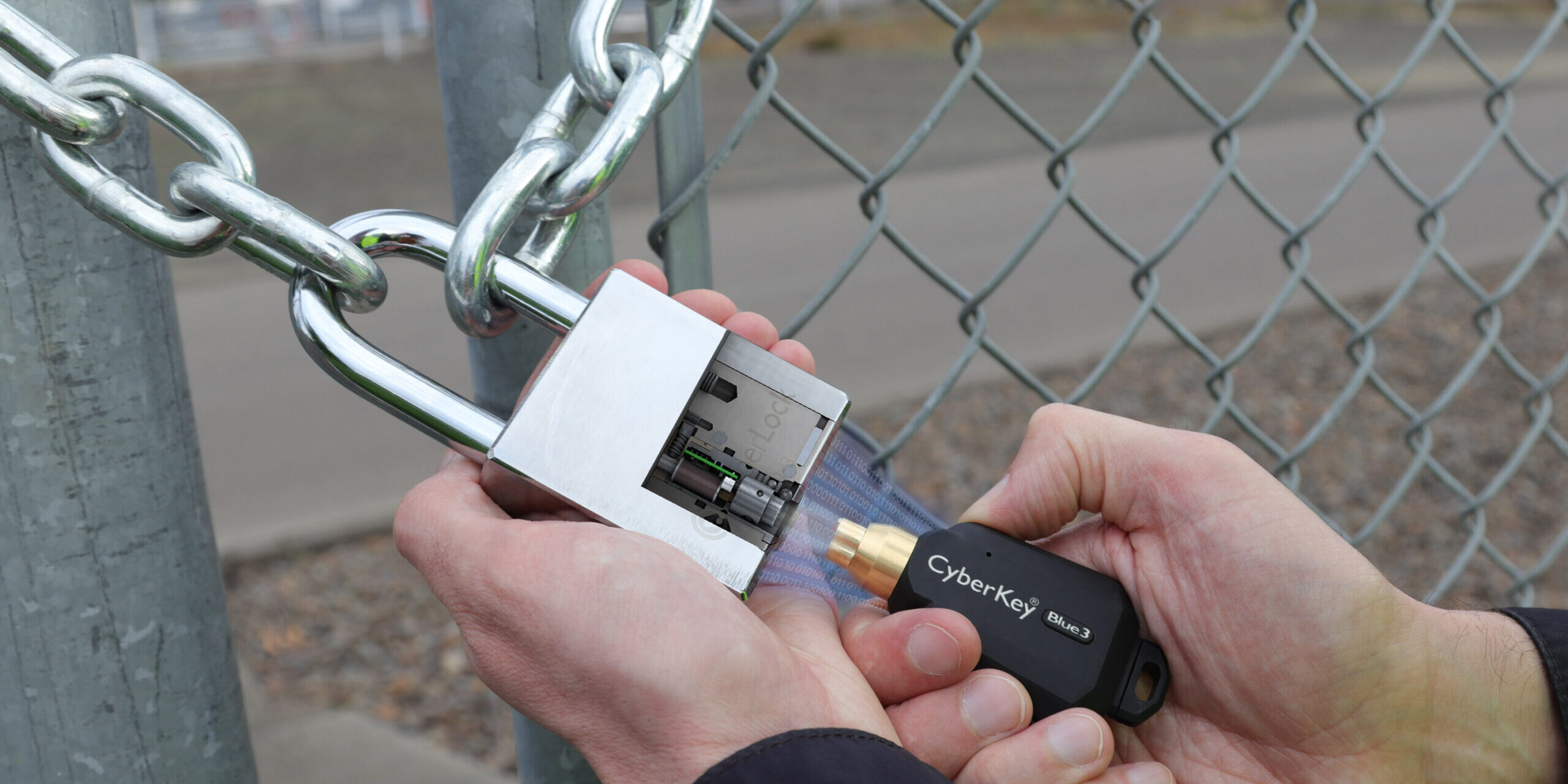
CyberLock addresses the same access control problem with a different architecture. The cylinder at the door contains no electronics, no battery, and no network connection. It is passive hardware. The electronic key carries the credentials.
When a key is inserted into a cylinder, it reads the cylinder’s unique ID and checks its internal permission table. If the key has been authorized for that cylinder, the lock opens. Every access event is logged on the key. When the key next connects to a CyberAudit-Web update station, the audit log uploads and updated permissions push to the key from the administration software.
There is nothing at the door that can be reached remotely because there is no remote connection at the door. The cylinder installs into existing hardware using one of over 450 available designs that match standard commercial and industrial lock formats. Installation is typically under 10 minutes per door. No conduit. No cable run. No wall work.
Credential management, including revoking access when an employee leaves or a contractor’s engagement ends, can be handled through CyberAudit-Web even with a fully offline, wireless lock system. The system is designed to give administrators that control without requiring a network connection at the door.
Access Control Systems in New Jersey: Which Facilities Belong in Which Category
Utilities and field infrastructure. Traffic control cabinets, substation entry points, and field equipment enclosures throughout New Jersey do not have LAN drops, and placing internet-connected hardware at roadside infrastructure introduces risks that are not acceptable for utility operations. CyberLock cylinders replace existing cam locks in these cabinets with no additional infrastructure. TEC Solutions has deployed CyberLock across traffic control and utility infrastructure throughout the New Jersey and New York City region.
Transit and transportation facilities. Platform-level doors, right-of-way access points, and maintenance facility entry points require access control that does not depend on network availability in the field. TEC Solutions has worked with the MTA since 2004. The initial engagement secured 100 access points around Madison Square Garden in four days before the Republican National Convention. The reason that the timeline was possible was the complete absence of infrastructure requirements at the door.
Older commercial and industrial buildings. A significant share of the commercial and industrial building stock across New Jersey was constructed before modern low-voltage infrastructure was standard. Facilities teams managing these properties face the same infrastructure challenge as their counterparts in New York City. CyberLock changes the project from a construction discussion to a hardware discussion.
Government and regulated facilities. Some facilities operate under policies that prohibit network-connected hardware within the physical access control layer. That is a hard requirement, not a preference. Offline access control is the only architecture that satisfies it.
Where cloud-based systems belong. Modern Class A commercial properties with structured cabling already at every door, multi-tenant portfolios where real-time tenant credential management is an operational priority, and organizations with the IT infrastructure and staffing to manage network-connected hardware throughout the building envelope are reasonable candidates for Brivo or a comparable platform. The point is not that cloud-based access control is a flawed product category. It is the infrastructure requirements attached to it that make it the wrong choice for a large portion of New Jersey’s actual building stock.
The Total Cost Difference for NJ Facilities
CyberLock systems typically cost roughly one-tenth of what a comparable wired access control installation costs in this market. That is not a hardware quality trade-off. The cylinders are hardened, pick-resistant, and built for high-use institutional environments. What is eliminated is the infrastructure cost: cable, conduit, network drops, low-voltage contractor labor, permits, and structural repair.
In New Jersey, facilities teams that have received quotes in the $80,000 to $120,000 range for wired access control across 30 to 40 doors consistently find that the CyberLock equivalent comes in well under that figure with a faster installation timeline and no facility downtime during the project.
Evaluating Your Facility’s Access Control Systems Options in New Jersey
The right access control architecture for a New Jersey facility depends on what the building can actually support, what the organization’s security and compliance requirements are, and what the total cost of ownership looks like over a multi-year horizon. That evaluation is worth conducting before committing to an infrastructure investment.
TEC Solutions is headquartered at 232 Madison Street, Hoboken, NJ, and has been serving facilities across New Jersey and New York City since 2001. As a platinum-level CyberLock partner for more than 20 years, TEC Solutions has deployed access control systems across transit, utilities, government, healthcare, and commercial facilities throughout the metro area.
Contact TEC Solutions at (888) 289-8911 or info@tecsolutionsinc.com to discuss your facility’s specific requirements.