






Most access control systems start with the same assumption: that you can run cable. For facility managers and security directors operating in New York City, that assumption fails more often than it holds.
Pre-war office buildings in Midtown where any structural penetration requires board review. Landmarked properties where wall work triggers a preservation commission process. Transit maintenance facilities where a network cable run to a platform-level door is a multi-week construction project. Utility infrastructure where there is no LAN at the cabinet, and there should not be. These are not edge cases in New York City. They represent a large share of the institutional and commercial building stock that organizations actually operate in.
Wireless access control for NYC facilities is not a convenience upgrade. For a significant portion of the organizations managing buildings in the five boroughs and the surrounding metro area, it is the only architecture that does not require a major infrastructure project before the first door gets secured.
Why NYC Facilities Resist Traditional Access Control
A standard wired access control installation runs low-voltage cable from a central controller to a reader at every controlled door. In a new construction project designed around that infrastructure, it is straightforward. In New York City, almost nothing a facilities team manages was built that way.
The barriers are specific and consistent. Landmarked buildings restrict structural alterations, which include the wall and ceiling penetrations, any cable run requires. Older commercial and industrial buildings have construction methods that make conduit installation slow and expensive. Transit and utility facilities operate on schedules that do not accommodate multi-day installation crews. And in every case, the low-voltage contractor labor rates in New York City are among the highest in the country.
By the time an organization prices out the infrastructure work for a wired system across a 40-door facility in Manhattan or the outer boroughs, the access control hardware budget is often already consumed by the construction work alone.
What Most “Wireless” Systems Still Require
There is a distinction that cloud-based access control vendors rarely emphasize: a wireless credential is not the same thing as a wireless lock.
Platforms like Brivo, Avigilon Alta, and Kisi are positioned as wireless or cloud-based systems. The credential that opens the door travels wirelessly, via Bluetooth or NFC, from a smartphone or fob. But the reader at the door is connected to your network. It communicates with a cloud server over your building’s LAN or Wi-Fi. That means every door you want to control still requires a network connection at the hardware level. In any building without existing infrastructure at the door, that means cable work.
For security directors at government agencies, utilities, and healthcare systems operating in New York City, there is a second problem. Every reader connected to your network and communicating with a cloud server sits within your building’s attack surface. For facilities operating under network segmentation requirements or strict cybersecurity policies, that is not a risk profile the security layer of a building can accept, regardless of how the cloud platform itself is secured.
Wireless Access Control NYC: How CyberLock Eliminates the Infrastructure Problem
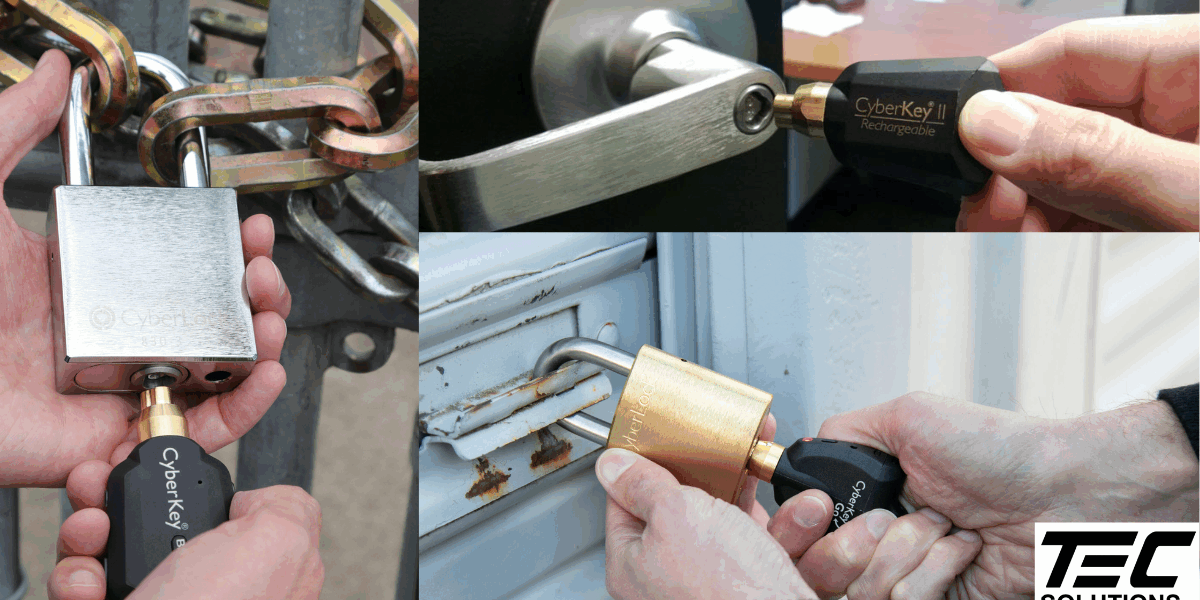
CyberLock uses an inverted architecture. The lock cylinder at the door contains no electronics, no power supply, and no network connection. It is a passive component with a unique identifier. The electronic key carries the credentials and the access logic.
When the key is inserted into a cylinder, it reads the cylinder’s ID and checks against the key’s internal permission table. If the key has been granted access to that specific cylinder, the lock opens. Every event is recorded on the key. When the key next connects to a CyberAudit-Web update point, the audit log uploads, and any updated permissions push back to the key from the software.
There is no network at the door. No cable run. No power supply in the cylinder. The cylinder installs into existing lock hardware using one of over 450 available designs that match standard commercial and industrial hardware formats. Installation is typically under 10 minutes per door with no wall penetration and no conduit work.
For a facilities team managing a landmarked office building in the Flatiron District or a transit maintenance facility in Queens, this is the difference between a project that can be approved and funded and one that cannot.
Credential Management on an Offline System
Credential management, including revoking access when an employee leaves or a contractor’s engagement ends, can be handled through CyberAudit-Web even with a fully offline, wireless lock system. The system is designed to give administrators that control without requiring a network connection at the door.
Who Uses CyberLock Across the NYC Metro Area
TEC Solutions has been a platinum-level CyberLock partner for more than 20 years, headquartered in Hoboken, NJ, and serving the full New York metro area. The organizations deploying wireless access control through TEC Solutions are institutional and commercial: transit agencies, utilities, government facilities, healthcare systems, universities, and large commercial property management companies.
Traffic control infrastructure throughout New Jersey and New York City is secured with CyberLock cylinders because field cabinets do not have network drops and should not have internet-connected hardware in the roadway. Government facilities use it because network-connected hardware in the physical security layer is not permitted. Older commercial buildings use it because opening walls is not an option the facilities team has.
The MTA relationship dates to 2004, when TEC Solutions secured 100 access points around Madison Square Garden in four days ahead of the Republican National Convention. No network. No power at the door. Four days, complete. That project established the model that TEC Solutions has applied across transit and infrastructure deployments in the region for two decades.
Getting Started for Your NYC Facility
If your organization is evaluating access control for a facility in New York City or the surrounding metro area, the right first question is whether your buildings can support the infrastructure that most systems actually require. For many NYC facilities, the answer to that question determines the decision before any feature comparison begins.
TEC Solutions is based at 232 Madison Street, Hoboken, NJ and has been serving facilities across New York City and New Jersey since 2001. Contact us at (888) 289-8911 or info@tecsolutionsinc.com to discuss your facility’s specific access control requirements.